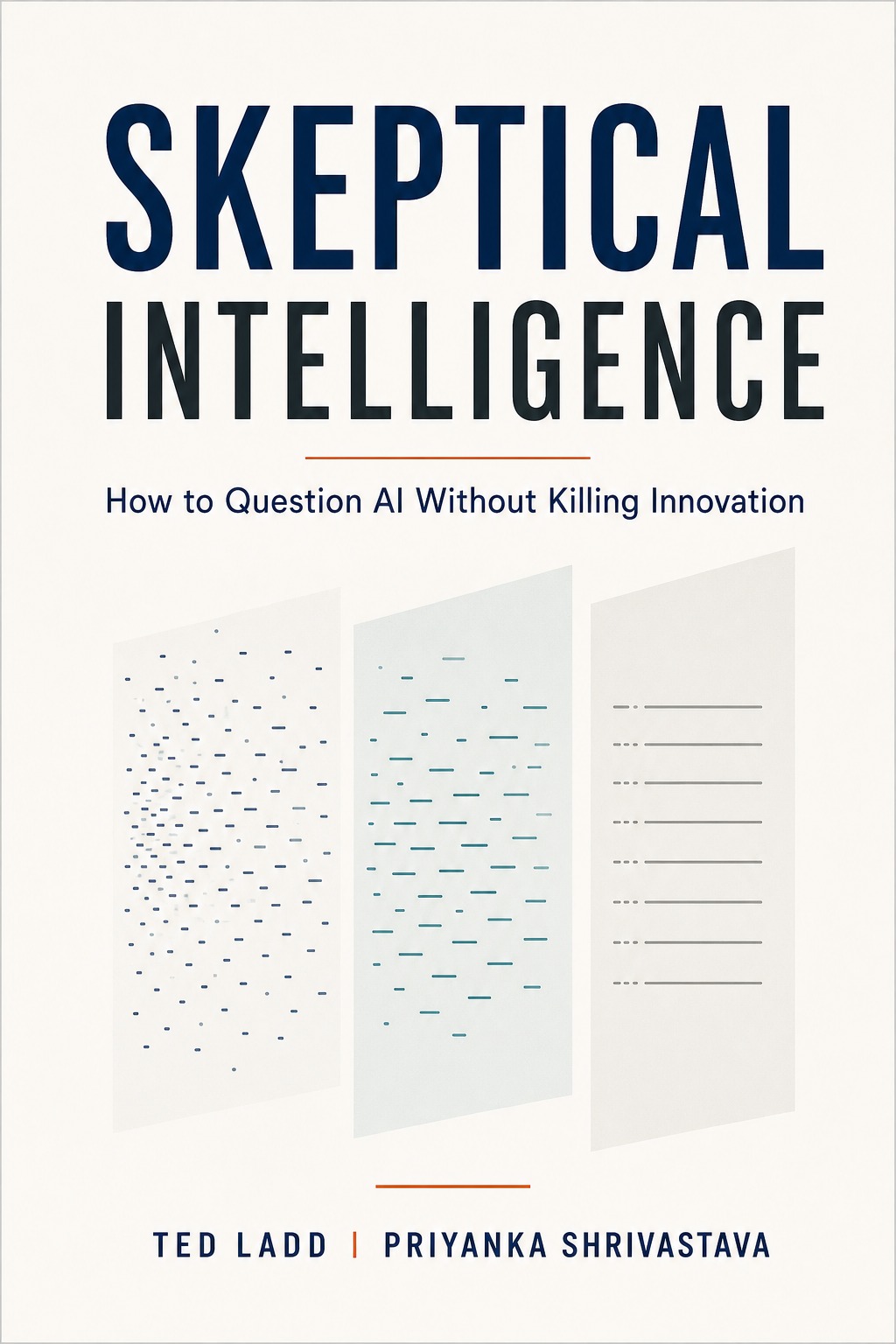
The book
A fourth capability for knowing when to trust AI
Publisher: Taylor & Francis · Publication date: July 2027 · Format: hardcover and ebook (final formats TBC)
The big idea
Most advice about critical thinking treats skepticism as one dial: turn it up when things matter, turn it down when they don't. That advice was built for a world where humans did all the reasoning. It breaks down in AI-mediated work, where a recommendation, a summary, or a forecast can arrive fully formed, stripped of the steps that produced it.
For decades, IQ and EQ were the two ways organizations measured capable people. AI was supposed to be a third: a tool that puts nearly all existing information into anyone's hands. Skeptical Intelligence argues that none of the three, on its own, tells a leader when to trust what a model just told them — and proposes a fourth capability to fill that gap.
Drawing on original survey research across six industries, the book breaks skeptical intelligence into four teachable habits — curiosity with an edge, epistemic humility, evidence discipline, and counterfactual imagination — and operationalizes them as SKEPTICS, an eight-step method for putting them to work under real time pressure. The goal isn't to slow decisions down. It's to know exactly when it's safe to move fast.
The result is a book for people who don't want to choose between moving fast with AI and getting burned by it.
Skeptics Playbook
Question Well. Decide Better.
The book's core framework turns the four habits into eight concrete steps, from stating the real decision to speaking your conclusion out loud.
What you'll learn
- Why "critical thinking" has become too broad a term to actually teach or measure — and what to use instead.
- The four habits behind skeptical intelligence: curiosity with an edge, epistemic humility, evidence discipline, and counterfactual imagination.
- SKEPTICS: an eight-step method for questioning an AI-generated answer under real time pressure, not in the abstract.
- Why raising a question out loud changes a team's culture more than raising it privately.
- How to build psychological safety so people are willing to risk being wrong out loud.
- What the research found about who tends to question and who tends to verify — and what that means for balanced teams.
- How to install skeptical intelligence at the organizational level: hiring, training, and what to reward.
Table of contents
- 01 Why critical thinking isn't enough anymore
- 02 A fourth pillar: skeptical intelligence alongside IQ, EQ, and AI
- 03 The four habits of skeptical intelligence
- 04 Skeptics Playbook, step by step
- 05 Building skeptical teams and organizations
- 06 Leading without slowing down
- 07 Measuring it: the Skeptical Quotient
Early endorsements
"A sharper, more usable idea than 'just think critically.' This book gives teams an actual method."
Name Surname, Title, Organization"A framework precise enough to survive contact with a real meeting, not just a slide."
Name Surname, Title, OrganizationGet the book
Where to find Skeptical Intelligence
US retailers
Also available internationally
Pre-order links go live closer to the July 2027 publication date. Join the newsletter to hear the moment they're up.