A research program and book by Ted Ladd & Priyanka Shrivastava
Skeptical
Intelligence
How to question AI — and everything else — without killing innovation.
Every leader has heard that AI will transform everything. What gets skipped is the harder question: when the volume of machine-generated answers explodes, how do you know which ones to trust? Ted Ladd and Priyanka Shrivastava's research names a fourth, teachable capability — skeptical intelligence — and this site holds both halves of it: the research and method, free to use today, and the book that brings them together.
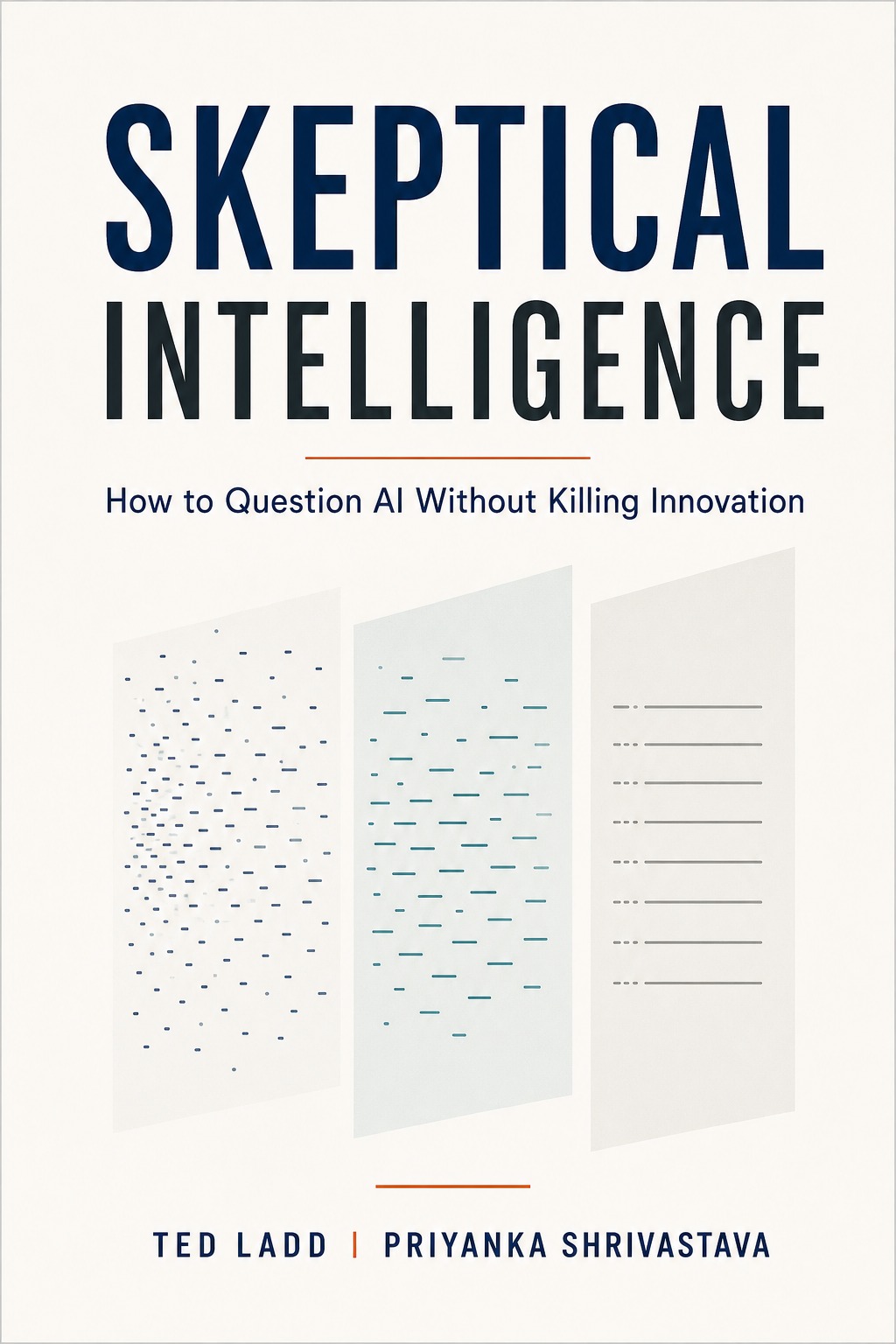
The book: forthcoming from Taylor & Francis, July 2027
The research
What is skeptical intelligence?
For decades, IQ measured raw intelligence and EQ measured emotional judgment. Now AI puts nearly unlimited information into everyone's hands — but none of the three tells you when to trust what a machine just told you. Ted Ladd and Priyanka Shrivastava's research names the missing piece: skeptical intelligence, a fourth capability alongside IQ, EQ, and AI itself, built from four teachable habits. Everything on this page through the resources below is free to use, independent of the book.
Ask what would change your mind
Look for what would disprove a claim, not just what confirms it.
Know the limits of what you know
Have an accurate read on what you — and your models — actually know versus assume.
Trace the claim back
Follow a claim to its underlying data, method, and assumptions before acting on it.
Generate the alternative
Build a plausible competing answer and test the original claim against it.
Skeptics Playbook
Question Well. Decide Better.
Eight steps for questioning an AI-generated answer before it shapes a decision you can't take back.
The eight steps
A practical routine for questioning an AI-generated answer before it shapes a real decision.
Solve
State what you're actually deciding, and why — push past the first version of the question to what's really underneath it.
Know
Write down your own preliminary answer before you look at the model's, so your judgment isn't contaminated by its language.
Evidence
Trace the sources behind the answer: how current they are, what's missing, and where the answer breaks down.
Phrasings
Rerun the question with the burden of proof reversed, and from a hostile skeptic's framing. See if the answer survives.
Tear down
Premortem it: how does this fail badly within a year? What question isn't being asked that should be?
Independent
Take it to a different model or a human expert. AI critiquing AI is not independence — shared training data means shared blind spots.
Conclusion
Map the evidence against the decision you set out to make. You decide. The model doesn't.
Speak Up
Voice your final conclusion and your remaining concerns to yourself and your team.
The Skeptical Quotient
Ted and Priyanka's research also produced a measurement scale for this skill, the Skeptical Quotient (SQ) — a first step toward letting individuals and teams assess their own ability to question and verify AI-generated claims. An online SQ self-assessment is in development; join the newsletter to hear when it's ready to try.
Downloadable resources
SI quick start guide
A short introduction to the four habits of skeptical intelligence and how to start using them this week.
Download PDFSkeptics Playbook team discussion worksheet
A guided worksheet to walk a team through applying the framework to a real, current decision.
Download PDFSample SI workshop agenda
A ready-to-adapt half-day agenda for introducing skeptical intelligence inside an organization.
Download PDFFor educators and trainers
Skeptical intelligence extends critical thinking training for a world where students and professionals reason alongside AI, not just about it. The four-habits framework gives instructors a concrete, teachable structure rather than a general exhortation to "think critically."
We're happy to talk about adapting these materials for a classroom, onboarding program, or internal training.
Contact us for teaching materialsThe book
The research above is ongoing and free. The book is where it comes together.
Ted and Priyanka keep publishing, speaking, and refining the Skeptics Playbook as the research develops. Skeptical Intelligence, the book, is the definitive version of that thinking — one field guide instead of a scattered series of articles and talks.
Who is this book for?
Leaders
Setting the tone for how a whole organization questions AI-driven recommendations.
Product & innovation teams
Balancing healthy scrutiny against the speed that new products demand.
Educators
Teaching a generation of students to work alongside AI without over- or under-trusting it.
Professionals working with AI
Anyone whose daily judgment now runs through an AI-mediated workflow.
Skeptical intelligence started as a research question, not a book proposal: what actually separates people who use AI well from people who get burned by it? "Think critically" was never a real answer — the term has stretched to mean almost everything and, as a result, means almost nothing. The book is where we put the research into one place. It isn't a reason to move slower. It's a way to know exactly when you're safe to move fast.
Ted Ladd & Priyanka Shrivastava
Two ways in
Use the research today. Get the book when it launches.
Skeptics Playbook and the four habits are free to use right now. Skeptical Intelligence, the book, publishes with Taylor & Francis in July 2027 — join the mailing list for early excerpts, workshop dates, and the moment pre-orders open.